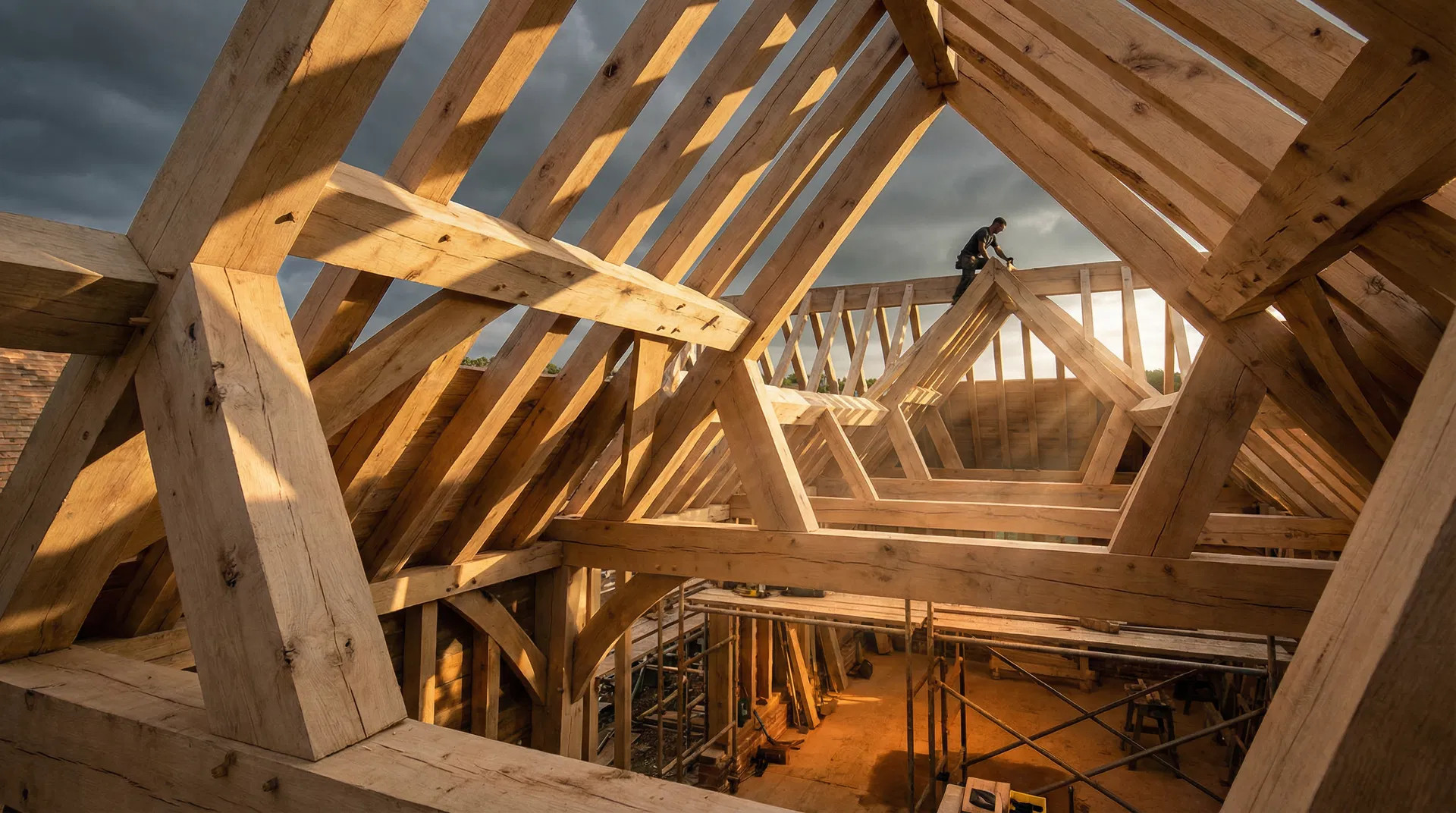
Cut Roofs & Structural Carpentry in Dorset: What You Need to Know
If you are planning a house extension or loft conversion in Poole, Bournemouth, or Dorset, you will likely encounter the choice between a cut roof and a trussed roof. Understanding the difference — and why it matters — can have a significant impact on the long-term value and flexibility of your home.
What Is a Cut Roof?
A cut roof is a traditional roof structure where every component — rafters, ridge boards, purlins, hips, valleys, and jack rafters — is individually cut and assembled on site by a skilled structural carpenter. The term "cut roof" distinguishes this method from prefabricated trussed roofs, which are manufactured off-site and craned into position.
Cut roofs have been used in British construction for centuries and remain the preferred choice for complex roof shapes, extensions, and any project where future loft conversion potential is required.
Cut Roof vs Trussed Roof: What Is the Difference?
| Feature | Cut Roof | Trussed Roof |
|---|---|---|
| Construction | Built on site by a carpenter | Prefabricated off-site |
| Cost | Higher (skilled labour) | Lower (factory production) |
| Loft conversion potential | Excellent — clear span | Poor — trusses obstruct the space |
| Complex shapes | Hips, valleys, dormers | Limited to simple shapes |
| Flexibility | High — modifications possible | Low — structural changes are difficult |
| Lifespan | 100+ years | 50–80 years |
Why Choose a Cut Roof for Your Extension?
Loft Conversion Potential
The single most important reason to specify a cut roof for your extension is future loft conversion potential. A trussed roof fills the roof space with a web of diagonal timbers, making a loft conversion extremely difficult and expensive. A cut roof leaves the roof space clear, meaning a loft conversion can be added at a later date with minimal structural intervention.
Complex Roof Shapes
Extensions often require complex roof shapes — hipped ends, valley junctions with the existing roof, and dormer openings. These are all achievable with a cut roof but difficult or impossible with standard trusses.
Matching Existing Roof Structure
On older properties with existing cut roofs, it is almost always preferable to match the new extension roof with a cut roof rather than introducing a trussed section that will behave differently under load.
Types of Cut Roof We Build in Dorset
Hipped Roof
A hipped roof has sloping ends as well as sloping sides — a classic shape for extensions and new builds in Poole and Bournemouth. Hipped roofs require skilled carpentry to form the hip rafters and jack rafters correctly.
Gabled Roof
A gabled roof has a triangular end wall (the gable) rather than a sloping hip. Simpler to build than a hipped roof, and often preferred for rear extensions where the gable is not visible from the street.
Mansard Roof
A mansard roof has a near-vertical lower slope and a shallow upper slope, maximising the usable space within the roof. Mansard roofs are commonly used for loft conversions and rear extensions in urban areas.
Valley Roofs
Where an extension meets the existing house at an angle, a valley is formed where the two roof slopes meet. Correctly forming a valley — with proper lead flashing and valley boards — is one of the most technically demanding aspects of structural carpentry.
Structural Carpentry Beyond Roofs
Ross-Read Carpentry & Building provides a full range of structural carpentry services in Poole and Dorset, including:
- First fix carpentry — stud walls, floor joists, flat roof structures, and timber frames
- Second fix carpentry — door linings, skirting, architrave, and staircase installation
- Timber frame construction — garden rooms, outbuildings, and new build frames
- RSJ installation — steel beam installation for load-bearing wall removals and open-plan conversions
How Much Does a Cut Roof Cost in Dorset?
Cut roof costs depend on the size and complexity of the structure. As a guide:
- Simple gabled roof for a single-storey extension (up to 4m wide): £3,500–£6,000
- Hipped roof for a single-storey extension: £5,000–£9,000
- Complex valley roof or mansard structure: £8,000–£15,000+
These figures cover the structural carpentry only — roofing felt, battens, tiles, and lead work are priced separately.
Get a Free Quote for Cut Roof Carpentry in Dorset
Ross-Read Carpentry & Building specialises in cut roofs and structural carpentry across Poole, Bournemouth and Dorset. This expertise is particularly valuable when planning a house extension, loft conversion or timber-frame project.
Call 01202 818288 or [request a free quote online](/contact) to discuss your project.